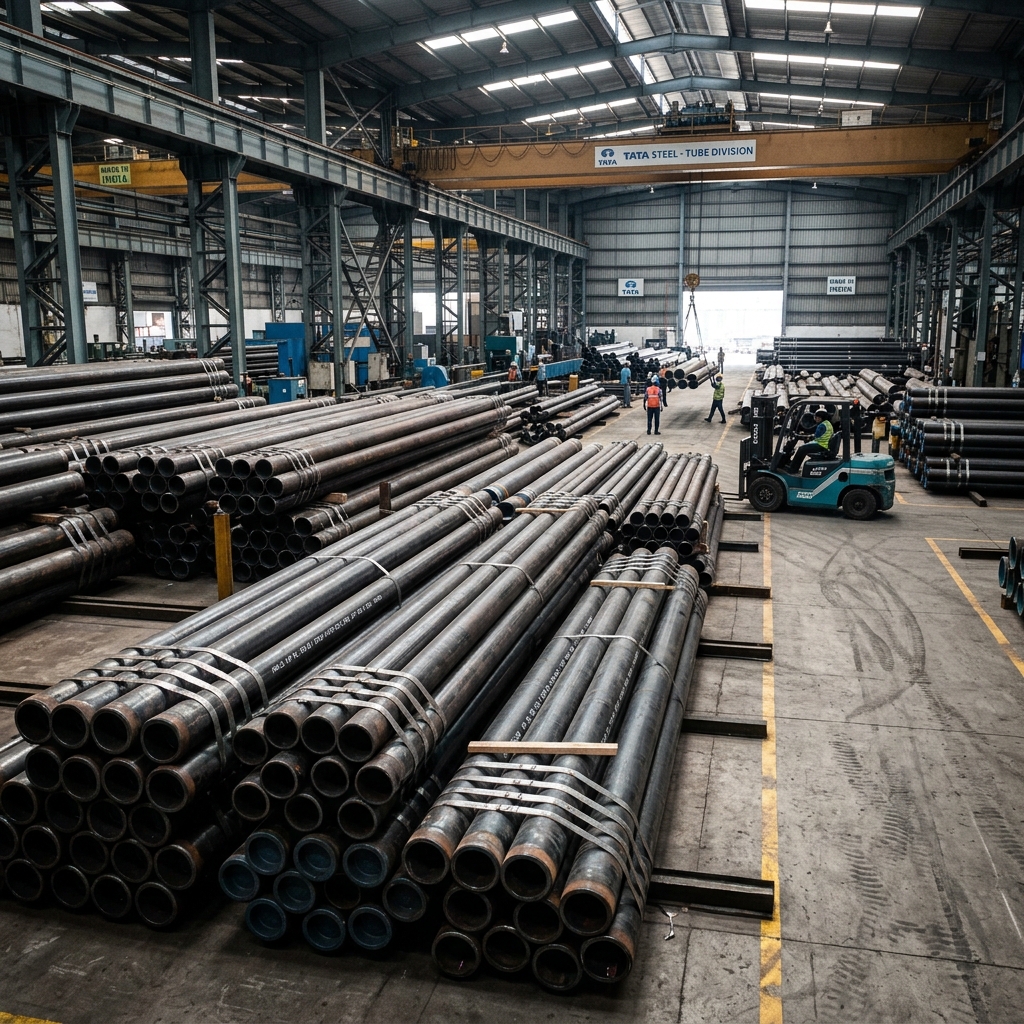
Steel pipes are the backbone of modern industrial engineering, infrastructure, oil & gas, and heavy fabrication sectors. From moving high-pressure fluids to supporting large-scale structures, their mechanical strength and adaptability make them irreplaceable.
When sourcing industrial steel pipes, understanding the differences between production methods, standard grades, and specific applications is key to ensuring project safety and budget efficiency. As a leading pipe and utility distributor in India, HS Infraproc supplies steel solutions across the country. In this guide, we dive into the major types of steel pipes and their respective industrial use cases.
Key Classification of Industrial Steel Pipes
Industrial steel pipes are broadly classified by their manufacturing method and structural shape:
1. Seamless Steel Pipes
Seamless steel pipes are manufactured by drawing a solid billet over a piercing rod to create a hollow tube. Because they do not have any longitudinal weld seams, seamless pipes have uniform structure and are rated to handle extremely high mechanical stress and fluid pressure.
They are the standard choice for boiler tubing, high-pressure steam lines, offshore drilling platforms, and refineries. Learn more about our specialized Carbon Steel Seamless Pipes range.
2. ERW Pipes (Electric Resistance Welded)
ERW pipes are manufactured by cold-forming steel sheets into cylindrical shapes and passing an electric current longitudinally along the seams to weld the edges together. Modern high-frequency ERW pipes are cost-effective, offer high dimensional precision, and are ideal for water transmission lines, low-pressure gas pipelines, scaffolding, and structural columns. Explore our certified MS Black & Galvanised ERW Pipes.
3. Structural Hollow Sections (SHS & RHS)
To meet structural and load-bearing requirements, round steel tubes are shaped into square and rectangular profiles. These are called Square & Rectangular Hollow Sections (SHS/RHS). They provide excellent torsional rigidity and structural efficiency, and are widely used in Pre-Engineered Buildings (PEB), airport trusses, bus shelters, solar structures, and cranes.
Major Steel Pipe Applications
Thanks to their robust design and pressure ratings, steel pipes are utilized across various fields:
- Fluid & Gas Transmission: Transporting potable water, oil, natural gas, chemical slurries, and steam.
- Structural Fabrication: Serving as piles, columns, PEB frames, highway gantries, and architectural frameworks.
- Machinery & Equipment: Used in automobile roll cages, conveyor idlers, scaffolding supports, and agricultural implements.
- Refineries & Power Generation: High-temperature boiler tubes, heat exchangers, and air pre-heaters.
Benefits of Steel Pipes in Industrial Projects
Why do civil and mechanical engineers prefer steel pipelines over other alternatives?
- Extreme Strength: Steel can withstand exceptionally high pressures, internal vacuums, and external mechanical loads.
- Heat & Thermal Resistance: Steel pipes operate safely under sub-zero temperatures as well as superheated steam environments.
- Custom Coating Options: To protect steel from rust, options like hot-dip galvanization, 3LPE (3-layer polyethylene), and FBE (fusion bonded epoxy) coatings are easily applied.
High-Quality Steel Procurement
Sourcing steel pipes for large tenders requires high-grade quality control. At About HS Infraproc, we source directly from primary manufacturers and supply products conforming to international and national standards (IS 1239, IS 3589, IS 4923, ASTM, API 5L).
Need technical specifications, price tables, or load calculations? Request a Quote or connect with our Delhi-NCR office for immediate logistics and inventory assistance.